

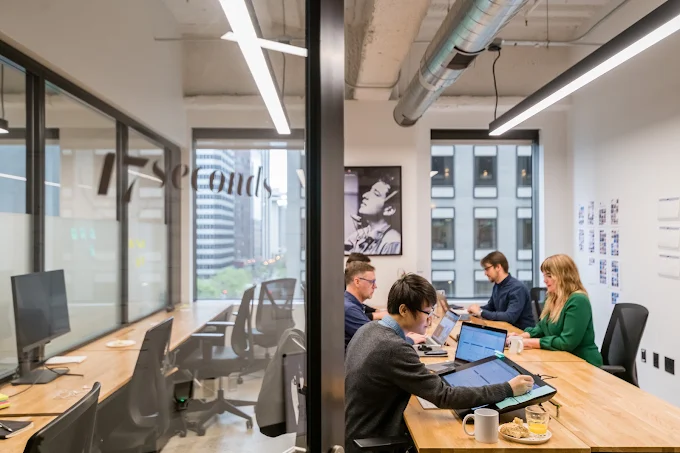
San Francisco spent three years as the cautionary tale of American office real estate. That story has turned. Vacancy fell to 30.1% in the second quarter of 2026, down from 33.8% a year earlier, and AI companies signed enough space to make the city the largest single contributor to national office absorption.
Rents are climbing again. You sit in an awkward spot: the market is recovering, your headcount plan for next year is still a guess, and a ten-year lease at $70 per square foot prices in a certainty you don’t actually have. A flexible membership sidesteps that timing problem entirely.
What Makes Flexible Workspaces a Good Fit for San Francisco in 2026?
Several advantages make flexible workspaces in San Francisco a better option compared to other office models. You move fast: a membership starts within days, not the nine months a lease, build-out, and furniture order usually take. Overhead drops too, since one monthly fee covers rent, utilities, cleaning, reception, and internet, rather than five separate line items you’d otherwise track yourself.
Hiring plans move in both directions. Your space can move right along with them instead of locking you into whatever number you guessed at signing. A hybrid team stops paying for empty desks every Monday and Friday. In San Francisco, your immediate neighbors are founders, VCs, and AI engineers. That network is invaluable here, and it carries a real business weight.
About 74% of companies worldwide now run some form of hybrid or flexible workspace model. CBRE found tenants hitting full capacity on peak days while averaging just 34% occupancy across the week. San Francisco knows the gap: office life peaks midweek.
The San Francisco Workplace Market Shift Taking Place
The San Francisco workspace market shifts towards recovery. That recovery is real, but not even. That unevenness is the foundation the flexible spaces are built on.
The Vacancy Numbers Behind the Shift
Vacancy closed the second quarter of 2026 at 30.1%, the lowest since the third quarter of 2023. Sublease space, the overhang that defined 2023, fell to 3.5 million square feet, its smallest total since early 2020. Asking rent recovered to $70.31 per square foot.
Why AI Companies Are Driving the Recovery Into Flex
AI tenants hold 9.36 million square feet in San Francisco, near 13.8% of leased space, and CBRE credits the sector with about 30% of all leasing since 2023 and more than three-quarters of net absorption. Anthropic passed a million square feet around its Mission Bay base. Assort Health moved into 62,400 square feet at One Market, more than tripling its previous footprint. These numbers reflect companies doubling headcount within a single funding cycle. At that speed, forecasting space 12 months out is impossible. That’s why AI demand hits flexible workspaces long before signing traditional leases.
The Financial Case: Flex vs. Traditional Lease in San Francisco
Lease costs scatter across a dozen budget lines. The ones that hurt sit outside the rent figure. Build a modest 2,000 square-foot office, and you spend thousands before a single person sits down. Add the cost of legal fees, permits, furniture, and IT, and you go far above the advertised lease. Flex looks expensive per desk and cheap against total occupancy cost. The number that makes more sense for you contributes to your decision.
What a 10-Person Team Actually Pays
San Francisco coworking sits around $235 per person per month at the market median. For ten people, it costs about $2,350 a month with meeting room credits, reception, fast internet, printing, and cleaning included. At Mindspace on Market Street, a location membership runs $500 per person, and All Access across the global network is $550, putting a ten-person team between $5,000 and $5,500 a month for a premium downtown floor. Set either against the lease path: hundreds of thousands in fit-out, amortized across a term you can’t exit, plus high rent figures per square foot, plus operating costs on top of that. A lease wins on cost per square foot at scale. Below twenty-five people in San Francisco right now, a lease doesn’t make sense.
Scalability Without the Penalty
Growth and contraction both cost money under a lease. Hire ten people, and you’re subletting or breaking a contract just to find room. Lose a funding round, and you keep paying for desks nobody uses – a scenario we often witnessed in San Francisco between 2022 and 2024.
Flexible terms change the game. You add memberships as you hire and drop them the moment a project ends. Making that call takes a conversation rather than a broker. A hybrid office suits the team that comes in three days a week, since you book desks by the day instead of carrying seats through Monday and Friday. Dedicated desks work for people who need the same spot daily, and a private office absorbs the team that outgrows the open floor. Moving between those tiers inside the same building takes a signature and a start date, nothing more.
Where SF Flex Spaces Cluster
San Francisco holds around 150 flexible workspaces covering 3.8 million square feet, close to 2% of the city’s leasable office space.
Financial District and Jackson Square for Transit and Prestige
Montgomery Street BART and the Embarcadero put clients and staff on the same transit line. Jackson Square pulls venture firms and law practices that want brick, low-rise buildings, and a walk to the Ferry Building. You pay for the address and the meeting rooms that come with it.
SoMa for AI and Technology Companies
SoMa carries the densest concentration of flexible space in the city, running from large campuses on Mission and Spear Streets to independents like Trellis. Proximity is the obvious advantage here. Major AI firms lease entire floors nearby, while their alumni launch the next wave right around the corner.
Mission District: Where American Coworking Actually Started
Brad Neuberg opened the first space called coworking at Spiral Muse in the Mission in 2005. The neighborhood still runs on that model, with smaller operators charging around $279 a month for round-the-clock access. Rates run under downtown, and the area sits closer to where many engineers actually live.
Market Street Corridor
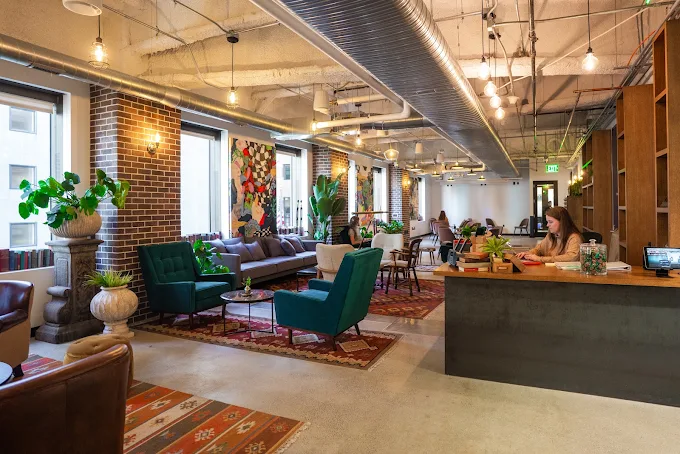
Market Street connects the two ends. The City of San Francisco took another 502,000 square feet at 1455 Market in 2026, the largest local lease the corridor has seen in a decade, which tells you where things are heading.
The San Francisco Community and Networking Scene
In San Francisco, your neighbor at the next desk is often the real reason you’re in the room. Sharing a room with YC founders and venture partners is everyday life here. In Denver or Nashville, you’d need an invitation.
Programming turns that proximity into introductions. Founder breakfasts and industry mixers run about twice a week at Mindspace Market Street, alongside occasional wellness sessions, all hosted by a dedicated community manager. Frequency beats total events: seeing the same faces builds a network, not just a mailing list. An introduction from someone who’s watched you work for six months carries weight that a conference badge scan never will.
The Importance of Workplace Design in San Francisco
Your real competition here isn’t another coworking floor. It’s a kitchen table with fast internet and no commute. That’s the bar any San Francisco workspace charging $500 a month has to clear.
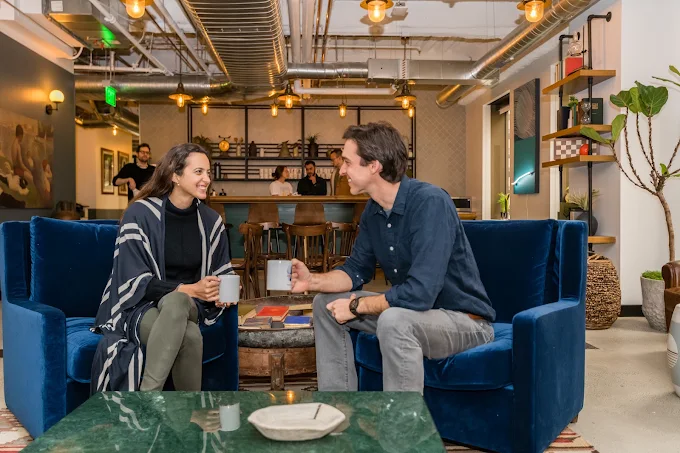
Design is what actually clears it: acoustic separation between phone zones and deep-work areas sounds basic and stays rare. Natural light, planting, and task zoning show up in the spaces that hold onto members, because people notice on the fourth consecutive afternoon rather than the first tour. Wellness moved from a perk to a product. Premium spaces now feature cold plunges, saunas, and breathwork sessions, because members treat energy management as part of their workday. Free drip coffee doesn’t come anywhere close to clearing that same bar.
What Mindspace at Market Street Delivers
Mindspace San Francisco occupies 36,000 square feet across three floors of the Market Center Building at 575 Market Street, on the line between the Financial District and SoMa. The Montgomery Street BART and MUNI station sits below the building. Moscone Center and the Ferry Building are both a ten-minute walk.
Each floor carries a unique atmosphere. You pick ambient energy or quiet depending on the work rather than taking whichever desk happens to be free. Coworking memberships start at $500 a month for the San Francisco floor and $550 for All Access across the whole Mindspace network. A day pass is $42 and a private day office is $125, which covers the visiting founder or the team running a two-day sprint. Meeting rooms start at $80 an hour with AV and IT support on hand. A virtual office at $125 a month gives you the 575 Market Street address and mail handling with no desk attached.
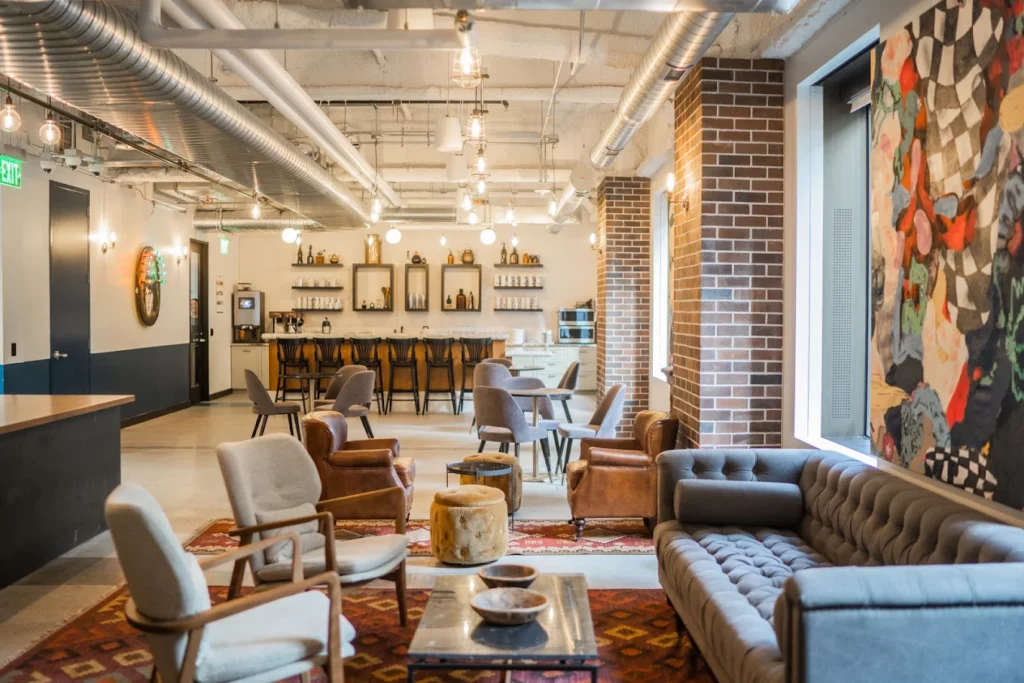
Private offices hold small and medium teams, and members reach a full-service gym and larger conference facilities through the sister-building partnership. Add 24/7 access and a pair of phone booths for private calls, plus a coffee bar and a policy that welcomes your dog on the floor. The building sits right on the boundary line, which matters if half your meetings run with SoMa engineers and the other half with Financial District investors. Our breakdown of office space by the hour in San Francisco covers which option fits which pattern of use.
Mindspace, WeWork, or Industrious: choosing flexible workspace in San Francisco
WeWork gives you scale and address prestige that most independent providers can’t match. San Francisco sites include 650 California Street, 353 Sacramento, and floors 36 through 38 of Salesforce Tower, and an All Access pass opens more than fifty US cities on one membership. If your team moves between offices most weeks, no other network matches that footprint. However, the spaces feel more corporate than some early-stage founders prefer.
Quiet is what Industrious sells. Its 945 Market Street site runs the hospitality model hard, with a member experience manager on site, daily breakfast, and phone zones kept well away from deep-work areas. The company grew its footprint 58% in 2025, so availability keeps improving if calm is what you’re after.
Mindspace wins on design and community, not sheer number of addresses. One San Francisco location, three distinct floors, programming running twice a week, and a team that actually knows members by name. You trade address count for attention, and for plenty of teams that trade works out in their favor. Our roundup of coworking spaces in San Francisco sets the full range of options against each other.
Conclusion
San Francisco is recovering on the back of an industry whose space needs change every two quarters. That’s a poor match for a ten-year lease, and a good one for a membership you can resize as those plans shift. Run the comparison on total cost of occupancy rather than cost per desk, and price in the fit-out you’ll never actually have to pay for. Visit two spaces on a day pass before committing to either, since the floor plan and the noise level decide more than any brochure will. Book a tour on Market Street, or start on a day pass and scale up once the hiring plan firms up. Our look at alternatives to a traditional lease covers the rest of what to weigh.
The Author

You might also like these reads — picked just for you.
Virtual Offices in New York: How Do They Work and What Are the Benefits in 2026?
You want a New York address on your invoices without paying New York rent, and a virtual office gets you exactly that. You rent a real commercial street address at a staffed building, someone on the team there signs for your mail, and you book a meeting room on the days you actually need to […]
Why Williamsburg Is the Answer to Your Team’s New York Commute Issues
If you are weighing where to base a team in New York, the first question is rarely about square footage. It is about the L train. Will your people spend two hours a day getting to work? Will clients agree to come out to Brooklyn? What happens on a Tuesday morning when the L runs […]

Miami Office Space Costs in 2026
Miami is now the most expensive office market in the United States. Average asking rents in Miami-Dade County climbed to $67.12 per square foot in Q2 2026, surpassing Manhattan and every other major US area. In June, Peter Thiel’s family office signed an 18,158 square foot lease at 830 Brickell for $250 per square foot, […]
