


London runs one of the world’s densest startup ecosystems, with investors, talent, and customers packed into a city small enough to cross in an afternoon. It also carries some of the highest commercial real estate costs in the country. A standard London office lease binds you for five to ten years, a commitment that quietly kills most early-stage companies before they ever find product-market fit. The flexible workspace is the structural answer to that mismatch. No multi-year lease, no six-figure fit-out, no scramble to sublet when the team outgrows the room. This article walks through what flexible workspace actually means, why London startups pick it over the fixed lease, which workspace type fits which stage of the business, and how Mindspace’s three London locations stack up.

Why Flexible Workspaces Are the Default Choice for London Startups
London startups choose flexible workspaces as a strategic step to deal with the city’s premium real estate prices. You shouldn’t bet your company’s future on a ten-year lease before you’ve even started. Flexible workspaces take that pressure off so you can focus on growth.
By 2026, flexible offices will have captured a significant and growing portion of central London’s real estate. All current data shows that this shift toward flexibility is accelerating and shows no signs of reversing. A new generation of leaders has rejected the idea of fixed, long-term office costs. They see rigid leases as an obsolete relic of the past rather than a requirement for success. Three reasons pull almost every London startup in the same direction. First, the financial protection during the early stages, when every pound committed to a lease is a pound not spent on engineering or go-to-market. Second, the ability to grow without triggering a relocation, because a flexible workspace lets you take more desks in the same building rather than packing up and starting over. And third, the immediate access to professional infrastructure from day one, which is the difference between pitching a client from your kitchen and pitching them from a meeting room on the 8th floor in a premium building.
The Benefits of Flexible Workspaces for London Startups
The benefits of the flexible workspaces for London startups are not abstract. Each one maps onto a specific problem that ends early-stage companies.
Financial Agility When It Matters Most
London’s commercial spaces aren’t cheap. Long leases signed too early are shutting down more startups than we realise. A fixed monthly contract means paying more than you need this quarter, no matter how optimistic the estimations looked. Flexible workspaces mean no upfront expenses, no deposits that swallow large amounts of money, and no landlord negotiations when your business dynamic changes. Instead of spending your pounds on walls and fixtures, you can save them for meaningful investments for your startup: hiring a great engineer, funding the customer acquisition test, or keeping the business alive long enough to position the product.
Scale Up Without Moving Out
A team of three becomes a team of fifteen faster than most founders expect. In a traditional office, that growth requires a relocation. The energy spent on packing, unpacking, getting the Wi-Fi reinstalled, and losing three weeks of productive time is a hidden tax on growing businesses. A flexible workspace lets you start with two desks, move into a private office for four, then take a team suite for fifteen as the headcount catches up, all inside the same building. You keep your address, your routine, and the team’s momentum. You don’t realize how important a smooth transition is until you’re trying to move offices and launch a new product in the same week.
A Community That Accelerates Growth
The best London flexible workspaces are ecosystems rather than rooms. The person at the next desk is running a Series A fintech. The founder in the lounge has just hired a head of engineering and knows three more candidates worth meeting. The investor who backed the company in the office next door is five minutes away for a coffee, not a week away for a diarised call. For a founder still building a London network, that ambient proximity is a structural advantage that a standalone office cannot reproduce, no matter how nice the decor.
A London Address That Does the Work For You
There is a material difference between a Shoreditch address and a residential postcode on a pitch deck. An EC2A or EC1V address tells a VC, a client, or a candidate that the business is where serious London companies are. Beyond the address, professional meeting rooms and event spaces back the signal up. The first time you bring someone in, the experience matches the impression. A flexible membership gives an early-stage company the front-of-house of a much larger business.
Built for Hybrid Teams From Day One
In London, the three-day office week is the new normal. Flexible workspaces are built for this reality, giving teams exactly what they expect. Hot-desking accommodates hybrid attendance without wasting space on empty desks on the days people are working from home. A hybrid office plan lets a small team share a pool of seats rather than allocating one per person, which cuts the cost of going hybrid by a third without anyone losing their place.
Types of Flexible Workspace in London
The right workspace type depends on stage, team size, and how client-facing the business is. These are not tiers in a hierarchy. Each one answers a different question.
Coworking Spaces
The most accessible entry point. Shared desks in a professional environment, available on a day pass or a monthly membership. Best for solo founders, freelancers, and early-stage teams who prioritise community and cost efficiency over privacy. What you get is the address, the amenities, the network, and the ambient energy of being around other people doing ambitious work. What you trade off is privacy for confidential calls and a guaranteed seat on a busy Tuesday. For most founders, the trade lands in the right place.
Dedicated Desks
A fixed desk in a shared space, the middle ground between hot-desking and a full private office. You get a permanent setup, lockable storage, and a reliable spot for the team, without the overhead of a sealed-off room. This suits founders who have outgrown dropping in with a laptop, need consistency for daily routines, and value being embedded in the community rather than behind a door.
Private Office Within a Shared Space
An enclosed, lockable private office sitting inside a larger flexible workspace. You get the best of both worlds: a private space to work and shared areas for meetings, events, and networking. Best for growing teams of around three to fifteen, businesses with regular client visits, and any founder who wants confidentiality without running a building.
Serviced Offices
Fully furnished, privately managed suites with dedicated reception, security, and full building management. The step up from a shared-space private office in terms of branding potential and operational control. This is the territory of SMEs that have graduated from the early stage and want a more established presence, or teams big enough that a self-contained environment starts to make sense.
Virtual Offices
A professional London business address and mail-handling service without physical occupation. A virtual office genuinely suits remote-first teams that still need a credible registered address, founders based outside London entering the market, and businesses that do not need daily desk access but do need the signal of a London presence. If you are pitching UK clients from anywhere else, this is often where you start.
The Best Areas in London for Startup Office Space
Location in London is not just a commute calculation. It is a signal about what kind of company you are, who you are likely to be sitting next to, and which ecosystem you are plugging into. Each area has its own character, and each one attracts a different startup community.
Shoreditch and Old Street: Tech and Creative
Home to Silicon Roundabout and the densest concentration of tech startups in the UK. The neighborhood has a confident energy, packed with creative agencies, venture capital firms, and the late-night spots that fuel them. Tech and creative startups thrive here because it’s easy to network, meet with investors, and hire skilled people who are already nearby. Two of Mindspace’s three London locations sit in this area, being close to the serious startup ecosystem that concentrates here.
The City and Liverpool Street: Finance and Scale
The City and Liverpool Street create a different business environment. Professional, well-connected, and suited to fintech, legal tech, regtech, and startups that deal with the financial services sector. Liverpool Street is perfectly connected. Thanks to the Elizabeth line, you can get across the city or to Heathrow in record time. Clients arriving from the City can walk to you. Investors based in Canary Wharf are a direct train away.
West London and Hammersmith: Connected and Commercial
Increasingly popular with businesses that need strong transport connections without the central London premium. Hammersmith has direct links to Heathrow, which matters for any company with international clients, frequent travel, or team members flying in from Europe. The atmosphere is quieter and more focused than the East End, and the mix of global media and fashion companies nearby makes it a natural base for startups operating in those sectors.
Holborn and Midtown: The Bridge Between Both
Geographically and culturally between the creative East and the corporate City. Holborn suits businesses that do not fit into either category, professional services firms, consultancies, and scale-ups working across sectors. The central location is a practical advantage for any company with schedules full of client meetings across London, because almost everything is a short hop.
Mindspace London: Three Locations, One Standard
The workspace you pick shapes how your team works, how clients read the business, and whether showing up every day feels like a pull or a push. Mindspace’s three London locations answer that question three different ways.
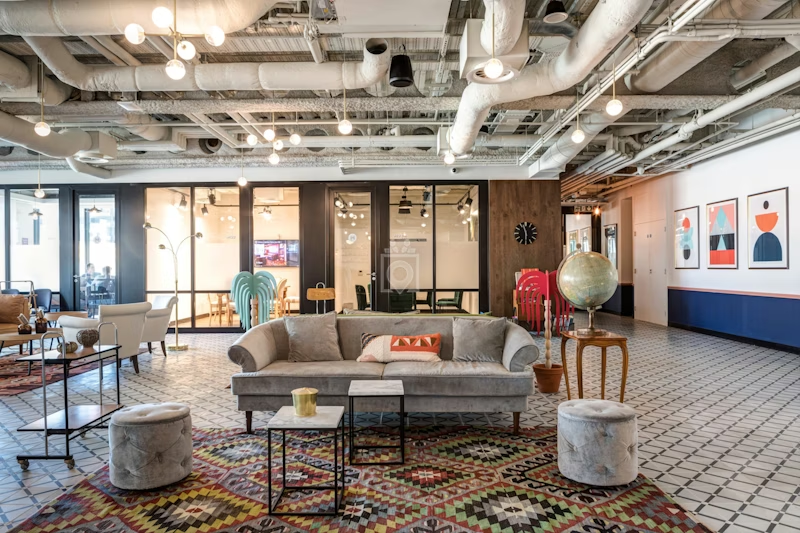
Mindspace Liverpool Street at 9 Appold Street, EC2A sits two minutes from the station, right where Shoreditch’s creative energy meets the City’s financial weight. The 8th-floor balcony and 9th-floor coffee bar handle first impressions, event space holds up to 150, and you’ll share the building with growth businesses like BMC, Consider, Fanzo, and Sequel. Pet-friendly, open round the clock, a natural pick for founders who want community and client-facing credibility in one postcode.

Mindspace Old Street in Churchill House at 142-146 Old Street is our newest London location, planted at the heart of Silicon Roundabout. Multi-floor private suites give growing teams room to stretch out, the 2,500 square foot communal area seats up to 80 for events, and the 20-seat boardroom handles premium client meetings. Gym access, twice-monthly wellness sessions, and a steady run of guest speakers round it out.

Mindspace Hammersmith occupies the Metro Building at 1 Butterwick, W6, across three floors where every office has windows. Fourteen meeting rooms seat up to 16 each, the on-site café covers lunch and coffee, and weekly yoga runs in the building. Private outdoor access and direct transport links to Heathrow suit businesses with international clients or west London commuters. The tone is calmer and more considered than the East End, which tracks with the companies that choose it.
How to Choose the Right Flexible Workspace for Your London Startup
Choosing the right flexible workspace in London for your startup shouldn’t be a checklist with items you’ll cross out. It’s a set of honest questions. Work through them, and the decision makes itself.
Start with stage and team size. A solo founder needs a different product than a seven-person Series Seed team, which needs a different product again than a scaling fintech hiring two people a month. Answer honestly about where you are today, and where you realistically expect to be in six months.
Then the location, relative to both clients and talent. If your week is meetings in the City, Hammersmith won’t deliver. Liverpool Street is a daily commute tax you do not need to pay if your team already lives in West London. Factor in where investors, customers, and potential hires are based, not just where the building photographs well.
Look at the total cost of occupancy, not the headline desk rate. Some providers advertise a low monthly price and then charge separately for meeting rooms, printing, coffee, and after-hours access. The real number is the one you pay, not the advertised one. Access to meeting rooms matters a lot because the moment you have clients visiting, you need somewhere to host them, reflecting well on the business.
Finally, community fit. Walk the space. Have a coffee in the lounge. Notice whether the other members feel like the kind of people you want to be around 40 hours a week. The right workspace makes this part obvious within 20 minutes of visiting.
The best way to decide is to visit. All three Mindspace London locations run tours, and seeing the building tells you more than any brochure will.
Conclusion
London is one of the best cities to build a startup, and one of the most expensive places in the world to occupy space. Flexible workspace closes that gap. You get the infrastructure, the address, and the community of a much larger company without the financial exposure that quietly slows early-stage businesses down. The model has become the default for a reason.
Mindspace runs three London locations, from Liverpool Street on the Tech City seam, to Old Street at the heart of Silicon Roundabout, to Hammersmith in the Metro Building. One standard of quality across all three, and a range of workspace options that scale with the business from the first desk to a full floor.Visit mindspace.me to book a tour at whichever location fits, or book online if you already know which one is yours.
The Author

You might also like these reads — picked just for you.
How to Become a Digital Nomad in 2026 Without Burning Through Cash
Working from a beach in Lisbon looks great on Instagram. Paying $80 for a SIM card on day three because you did not plan the boring parts looks like nothing at all. Becoming a digital nomad in 2026 is more accessible than it was five years ago, with proper visas in roughly 60 countries and […]

Communication in the Workplace: How Flexible Workspaces Can Help
A Tuesday standup runs ten minutes long because nobody can find a meeting room. The new hire has been at the company for three weeks and still has not met half the team in person. A client question sits in Slack for six hours because the lead engineer is heads down. Most modern communication problems […]

Miami’s Founders Took the Stage at Mindspace Wynwood
On May 15, Mindspace Wynwood hosted the third annual Big Pitch Night, and if Miami needed any more proof that it’s become a serious hub for founders and operators, this was it. The evening brought together entrepreneurs, investors, and members of Miami’s startup ecosystem for a night of live pitches, expert feedback, and real community. […]
