


With return to office policies standing out as a polarizing topic between employers and employees, there is an evident demand for workplace flexibility. One trending approach, although not new, is the hub-and-spoke work model or the use of satellite offices, one of the best alternatives to commercial office property. Part of the office hub-and-spoke work model, satellite offices offer many advantages for both employers and employees, as companies reach beyond the city’s boundaries – and sometimes even beyond the borders. Here is everything you need to know about satellite offices, what is hot desking for shared offices, and why your company should explore this option.
What is a Satellite Office?
A satellite office is a secondary business location operating physically separate from a company’s primary headquarters. Organizations establish satellite offices to access regional talent pools, reduce employee commute times, minimize operational expenses, and expand into target geographic markets without moving existing core operations.
The hub-and-spoke work model that this falls into consists of a “hub” that hosts the company’s headquarters – often in the city center – and of “spokes”, or smaller furnished offices, often closer to where employees live. For remote workers, a spoke may be a cozy workstation at home, a local café with a wi-fi connection or even a shared desk in a coworking space. However, spokes usually refer to satellite offices – smaller branch offices of a company, spread across less central locations.

What Kind of Companies Use Satellite Offices?
Growing Businesses
Growing your business is exciting. But it can also be risky, and a bit scary. As a company allocates necessary resources to its expansion, exploring the advantages of working from different locations becomes crucial — a growing business can save money on any necessary additional workspace by opening satellite offices.
Instead of opening new branches, opening a satellite office can make work and growth safer and more efficient. In a satellite office, some of the operations – such as HR or IT services – can still be managed from headquarters. In addition, testing the waters of a new market on a smaller scale that a satellite office could support, also provides a great advantage. Flex office providers can host satellite offices and help growing businesses gradually scale up.
Companies Seeking Partnerships with Other Businesses
A successfully growing business is all about its connections and partnerships. A great way to be more attractive for a business partnership is to actually be present.
For instance, if the company’s main office sits in an industrial area, but you would like to network and form connections with hi-tech companies in a business zone further away, a satellite office might do the trick for you. You don’t have to relocate the entire company to where all the buzz happens, but you could open a smaller satellite office to be where your potential collaborators are.
Businesses Seeking to Expand Geographically
Whether their goal is to reach new markets, extend their customer base or employ new talent, businesses that are seeking to expand geographically are out for an adventure. Satellite offices could make this adventure possible – with less risks and lower costs.
Instead of opening an entire new branch in a different city or country – and sometimes even on an entirely different continent – venturing further using a satellite office could provide a great solution. An office space in a coworking venue could even be an optimal baby step to make, in order to take off in an entirely new geographic location.
Businesses Targeting a Specific Talent Pool
If your company’s HR department wants to recruit a very specific type of employee, then providing the potential new hires with a close to home office space, could be in your favor. For example, if you’re looking to hire those that freshly graduated from an exclusive program, setting up an office in their college town could lure them to your company.
Businesses targeting a specific talent pool should make it convenient for their potential employees to get to work, with shorter commute times. Opening an entirely new office costs a lot, so setting up a satellite office is an excellent way to go about it.
Companies Wanting to Improve the Quality of Their Customer Service
In order to rank high on customer satisfaction, providing high quality customer service is vital. One aspect to improve customer service is to have a quick response. Cutting the commute time is one way to resolve this. Therefore, several satellite offices spread over the main customer locales would improve the service.
The Benefits of a Satellite Office
Satellite offices lower your real estate costs, shrink your team’s commute, and keep customer service close to the people you’re serving, all without the overhead of opening a full second headquarters.
Satellite Offices Cut Down Commute Time
You know the drill: you rise and shine well-rested after a good night’s sleep, sip your coffee, and hit the road on your way to work. By the time you get there, X many hours after driving your car at close to 0 mph and listening to the deafening orchestra of honking – you’re anything but relaxed. And now you have to start your workday.
According to the Pulse of the American Worker Survey conducted by the insurance company Prudential, 46% of surveyed employees listed saving time by not commuting as an advantage to working remotely. Satellite offices in the hub-and-spoke model provide just that.
Setting a satellite office outside of the boisterous city enables employees to evade traffic jams and cuts their commute time significantly. Positioning the satellite office in an easily accessible location, such as by a major highway, may further enhance this benefit. And there’s another plus – less frustration caused by heavy traffic should increase employees’ productivity.
For example, there’s a reason why New York City is considered the global capital of commerce. But if you or your employees are tired of commuting each day to the hustle and bustle of Wall Street or another spot of Manhattan’s Financial District, working in a different neighborhood could shorten your commute time and lower your stress level. Mindspace Williamsburg offers a flexible office space for rent in Brooklyn – presenting a luxurious setup for a satellite office, with boutique meeting rooms and a view of the Manhattan skyline.

Lower Costs
Satellite offices can help your company lower costs. To begin with, time is worth money. So getting to work faster also means lowering travel expenses. Even just providing a satellite office with one or two meeting rooms, away from HQ, but closer to the customer base or to potential business partners, helps to save some cash.
In addition, in contrast to another branch of the company, a satellite office can still rely on various operation services centralized at HQ. It’s a fantastic way to get the work done, where it’s actually needed, without wasting resources.
Efficient Customer Service
Satellite offices can make customer service more efficient:
- They allow for a faster response time.
- They can sit closer to the customers, so the company understands their needs better.
- They can be part of a close to home network of business, providing a more wholesome solution.
Connection to a Local Customer Base
Instead of doing extensive market research about your customers based in another town or state, being geographically close to your customers will help you get to know them better. Being close to a local customer base, and even part of the community, could also form a stronger customer loyalty to your business.
Keeping Company Culture Alive
Satellite offices combine the benefits of working from anywhere with getting an inspirational face-to-face interaction. Another interesting piece of data from Prudential’s survey shows that “2 in 3 remote workers believe in-person interactions are important for advancing their careers”. Be it in a team meeting, from a hot-desk surrounded by a mosaic of fascinating people, or over a water cooler chat – the office is where all the action takes place.
Ongoing technological innovation, such as teleconferencing and an array of online tools, makes communications among the hub and the spokes easier than ever and allows employees to feel included. By allowing employees to work from satellite offices, closer to home, they still feel part of the company culture without facing the disadvantages of long commutes to the hub.

Reaching New Markets and New Talents
Besides aiding in talent retention, satellite offices can attract new talents in the hiring process. Getting geographically closer to potential employees’ homes is important since “63% of workers would not add more than 15 minutes to their commute each way for their ideal workplace”, according to Savills’ What Workers Want survey. This would also broaden the pool of contingent workers.
Moreover, satellite offices can increase workplace diversity. Hiring remotely, no longer limited to employees that reside close to the company’s hub, opens doors to different demographics. But this is much more than taking action on DEI (diversity, equity, and inclusion); it is long-proven that diversity boosts innovation.
Additionally, expanding beyond the borders of the metropolitan hub can open a whole new market. Reaching new leads, potential customers and business development opportunities is key for growth.

The Hub-and-Spoke Model is More Sustainable
Fitting real estate to the company’s needs can cut down unnecessary costs. Downsizing and thus lowering operation costs at the headquarters, while enjoying the agility in scalability offered by flex office providers, such as Mindspace, to gradually grow outside of the city is an efficient solution for the post-pandemic era.
A study published in the journal Sustainability showed that opening a satellite office “leads to less carbon emission and fuel consumption, and the infection probability decreases as office capacity reduces as well.” It also supports the economy in towns and cities outside of the metropolitan area by providing more job openings and using local services.
Reputable Address
Even if a company’s main offices are not in the best side of town, having a satellite office in a nicer area could set the clients more at ease. You don’t need to have a big office space – even just a dedicated desk in a coworking space like the London Old Street coworking, with available meeting rooms for rent, could do the trick.

Part of the Green Scene
The pandemic has taught us the value of connecting to nature. And, indeed, many people want to get away from the hustle and bustle of the city, and to build their lives in a green and calm environment. After a record number of people left New York City during the pandemic to the suburbs or elsewhere, there is no reason to rule out companies expanding out of urban areas as well. One way to do so is with satellite offices.
For example, the green surroundings of the Mindspace flex offices in Yakum, Israel, offer the serenity and peace of mind that both employees and employers are craving. This change of scenery can be a source of inspiration and creativity, lowering stress levels and increasing focus on work at the same time.
Also, many of our other offices are near green areas, such as our Williamsburg office space for rent in New York City, which is situated inside a landmark building featuring plenty of outdoor space and overlooking East River. Also our flex office in Philadelphia is only minutes away from Dilworth Park—a pedestrian-friendly area with plantings, lawns, and a fountain. Even our London Hammersmith office space has access to a great outdoor green area. Such green areas are the perfect place to recharge, after work or on your break.

Things to Consider When Opening a Satellite Office
Location and Accessibility
It’s important to pick the right location for a satellite office. Think about what is right for your business goals. Does your business need to be accessible to certain customers? Would you like to be close to the city, accessible by public transportation or next to a big highway? Are there any potential business partners that have their offices nearby?
For instance, Mindspace recently opened three new locations in Israel, each with its own set of benefits:
- Mindspace Park Ofer East: close to leading high-tech companies and major highways; easily accessible by public transportation; close to restaurants, shops, a barbershop, dry cleaning and a carwash.
- Mindspace Park Ofer HaCarmel: in the heart of a thriving hi-tech community; close to the prestigious Matam Business Park housing Intel, Microsoft, Apple and GE; provides gorgeous ocean views.
- Mindspace Kiryat Ono: close to the suburbs and an ideal solution for employees who live in neighboring cities; seamless commute as it’s adjacent to Highway 471 and just a mere 7 minutes from Highway 6.

Cost
Setting up a satellite office can help you save money, depending on your company’s strategy and goals. One way to scale up (or down if necessary) is to rent a private office or even a team suite in a coworking or a flexible office space.
Infrastructure and Logistics Between Offices
Ask yourself which company operations could be shared among the company’s offices and how the staff from HQ could support the satellite office’s logistics. This, of course, also depends on the distance between the hub and its spokes.
What Services Does a Satellite Office Offer?
A satellite office typically comes with mail and package handling, on-site IT support, and daily coffee service, plus perks like a lounge or roof deck, secure parking, and access to a fitness area, depending on the provider.
For instance, in addition to all of Mindspace benefits such as mail and packaging handling, IT services, and a delicious coffee, Mindspace Williamsburg in Brooklyn, New York, offers an array of amenities to support employee wellbeing: a communal roof deck and private rooftops for some air and view, on-site car parking, on-site bike parking spaces, and a fitness center with Peloton bikes, meditation pods and a bouldering wall.

Flexibility
Before renting a satellite office, another point to consider is whether to go for a low-commitment, flexible lease or a long-term, traditional lease. Flexible office or coworking space providers allow for flexibility to scale up or down as necessary – a great advantage when just opening a new office.
Home office vs. satellite office mentality
A home office runs on individual autonomy, while a satellite office runs on shared accountability inside a smaller version of company culture. When you work from home, you set your own rhythm and answer mainly to yourself between meetings. Walk into a satellite office instead, and you’re back inside a structure: coworkers nearby, a manager’s expectations in the room, and a physical space that reinforces you’re still part of something larger than your own kitchen table.
That difference shows up fastest in how people handle interruptions and ambition. Someone working from a spare bedroom often has to fight to keep their workday contained, since the couch and the laundry pile never clock out. Someone at a satellite office in a coworking space walks into a dedicated desk, drops into a rhythm shaped by the people around them, and leaves that mindset behind when they head home. Career-minded employees also tend to gravitate toward the satellite setup, since face time with colleagues, even away from headquarters, still counts for more than a Slack message when promotion conversations come around.
Satellite office vs. branch office
A satellite office typically shares core services like HR, payroll, and IT with headquarters, while a traditional branch office runs those functions independently. That distinction matters more than the size difference people usually assume separates the two.
Open a branch in a new city, and you’re often standing up a self-sufficient operation: its own management layer, its own vendor contracts, its own back-office staff. A satellite office skips most of that. A team can plug into a flexible workspace, lean on headquarters for payroll and IT support, and focus their local hires purely on the work that needs a physical presence there, whether that’s sales calls with nearby clients or engineering work close to a specific talent pool. The lighter footprint is exactly why companies like Google and Deloitte use satellite offices as a lower-risk way to test new markets before committing to anything closer to a full branch.
Working in a satellite office
Working from a satellite office gives you most of the community and structure of headquarters without the long commute that usually comes with it. You still get a desk, a team around you, and a manager who can see you’re actually working, just without the hour on a train to get there.
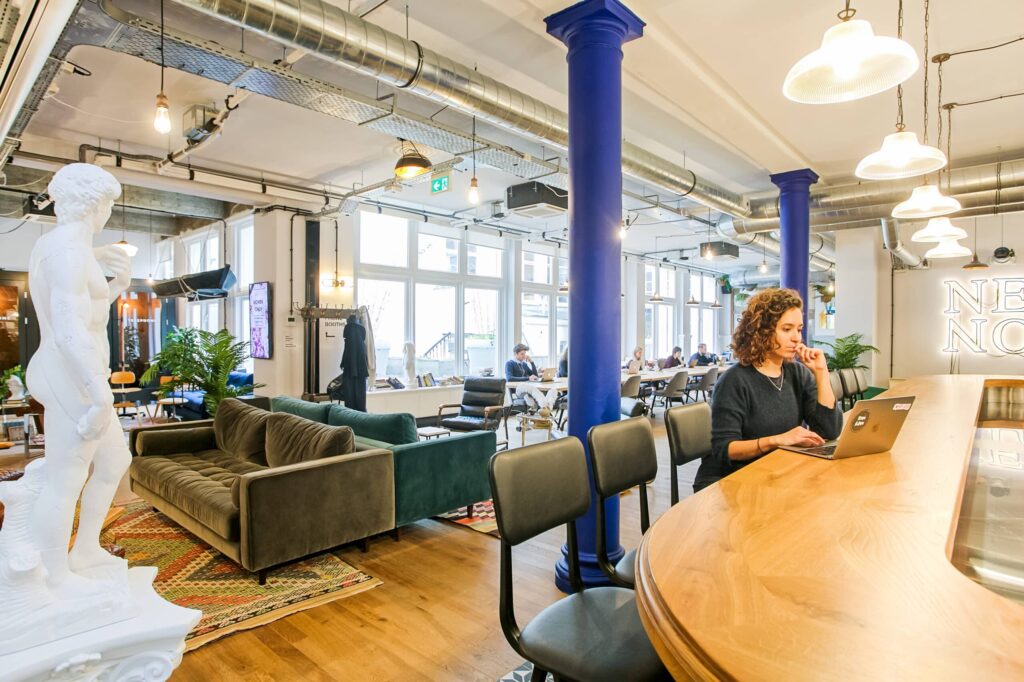
Picture someone at a flex-office location starting their day with coffee at the on-site bar, dropping into a private call booth for a client meeting, then stepping outside during a break to a nearby green space instead of staring at the same four walls all day. That’s a real workday, not a remote-work compromise. Employees in satellite offices also stay connected to headquarters through the same video calls and shared tools everyone else uses, so a project update from a smaller regional office lands in the same meeting as an update from HQ. The tradeoff is smaller talent overlap day to day. Your satellite office might have twelve people instead of the two hundred at headquarters, which means fewer hallway run-ins but tighter relationships with the coworkers you do have.
Satellite teams and flexible office space: the real challenges
Running satellite teams out of flexible office space creates two recurring problems: keeping company culture consistent across locations, and coordinating logistics between a hub that doesn’t always know what a spoke needs. Neither is a dealbreaker, but both need a plan before you sign a lease.
Culture dilution shows up first. A twelve-person spoke office can start to feel like its own company after a few months if nobody from headquarters visits, and local habits creep in that don’t match how the main office actually operates. The fix usually involves regular in-person visits from HQ leadership and treating the satellite office’s local events, not just its output, as worth investing in. Logistics create the second friction point: deciding which operations stay centralized at headquarters and which need a local presence at the spoke, especially when IT tickets or HR requests get stuck waiting on someone three time zones away. Flexible providers reduce some of this by bundling IT support and admin services into the lease itself, whether that spoke sits in a coastal tech hub like Herzliya or a walkable downtown like Philadelphia, but the coordination between hub and spoke still needs an actual owner, not an assumption that things will sort themselves out.
Flexible Office Providers for Corporate Satellite Teams
Flexible office providers let your company open a satellite location without signing a traditional lease, so you can rent a single hot desk for one remote hire or a full team suite for a twelve-person satellite office. For a company that considers incorporating the hub-and-spoke model, flex office providers, such as Mindspace, may present a flexible turnkey solution. Coworking or flex office spaces allow for companies to open satellite offices according to their current needs and employee work patterns – from a hotdesk for a remote worker in Miami to a private London office for a team developing the next big idea in another part of the world.
After taking all of the above into consideration, keeping your business goals in mind, you can browse through our locations in Europe, Israel and the US, and through our office solutions to find a satellite office for your company.
Learn more about our flexible office spaces and don’t hesitate to get in touch!
The Author

You might also like these reads — picked just for you.

Where to Rent Office Space in Amsterdam: Best Areas Compared
Amsterdam squeezes a remarkable range of business districts into a city you can cross by bike in half an hour. Pedal from a glass tower in Zuidas to a gabled canal house in the centre and the rent, the neighbours and the impression you make on clients all shift along the way.

Amsterdam Office Rental Prices: Why Flexible Workspace Is the Smarter Choice
You're comparing Amsterdam office costs, and the first numbers you'll find look almost too clean. A conventional lease runs 175 to 425 euros per square metre a year, depending on which postcode you're chasing. A serviced or flexible desk runs 250 to 800 euros a month, sometimes more, again shaped by district and building quality. Line those two numbers up side by side and the lease wins on paper, every time.
Renting a Small Office in Amsterdam: A Guide for Growing Teams
So your team is growing, and the spare room, the café corner and the borrowed meeting table aren't cutting it anymore. But you've still got options. When you rent a small office in Amsterdam, you're choosing between a dedicated coworking desk, a fully furnished private office, or a traditional commercial lease.
