

Coworking stopped being a workaround a while back. In 2026, most companies aren’t asking whether flexible space makes sense, they’re asking how much of it they need, and that shift changes what people actually get out of a membership. You’ll find ten of those benefits below, the ones that come up again and again among freelancers, hybrid teams, and employees at companies that have moved part of their real estate into shared space. Each one includes what to expect day to day, plus a short section further down on choosing the right space now that quiet zones, private suites, and open collaboration areas all tend to sit under one roof.

The top 10 benefits of coworking spaces
The top benefits of coworking spaces center on increased productivity through shared accountability and unparalleled networking opportunities within a diverse community. These flexible office solutions improve work-life balance by establishing clear boundaries, while reducing overhead costs by eliminating long-term leases. Ultimately, shared environments boost creativity and drive business growth through scalable, all-inclusive workspaces.
1. Increased productivity
Increased productivity is one of the top benefits of coworking spaces. This means getting more done in the same number of hours, and it’s consistently the most cited benefit of coworking spaces. Sit next to other focused people for a few days and something shifts. A sense of accountability creeps in, the kind that keeps you on task without anyone saying a word. A change of scenery from your usual desk does the rest, breaking the habit loops that come with working from the same four walls every day.
2. Network and collaboration opportunities
Networking in a coworking space means running into potential collaborators, clients, and hires because you share a building with them, no event required. Ideas move fast over a shared kitchen counter or in the open seating near a window. You get to know the people working next to you, and some of those conversations turn into real partnerships down the line. Coworking providers often add happy hours and professional events on top, giving you a reason to meet people outside your usual circle.
3. Build structure to work-life balance
Structure, in this context, means a clear line between when you’re working and when you’re not, something that gets harder to hold onto once your kitchen table doubles as your desk. Working from home blurs that line fast, and burnout follows close behind. An office gives your day a shape: a start, an end, a clear signal for both. Coworking spaces build on that with dedicated desks and communal areas meant for downtime, so focus happens during work hours and rest happens somewhere else. Wellness programs and small perks reinforce the same boundary, and the payoff shows up in job satisfaction and how long people stick around.
That boundary matters more now that hybrid work is the default rather than the exception. A lot of teams split their week between home and a shared space specifically because the space, not the calendar, is what actually enforces the line.
4. Promotes business growth
For a growing business, coworking means access to a built-in network of other companies without the overhead of managing an office. Startups and small teams land in the middle of a mixed community of professionals from different industries the moment they move in. That mix creates real openings for partnerships and knowledge-sharing, and it sparks ideas nobody would have reached working alone. Scaling up means renting another desk or a bigger suite, not signing a new lease, and someone else handles the facilities so you can put your energy into the business itself.
5. Creativity boost
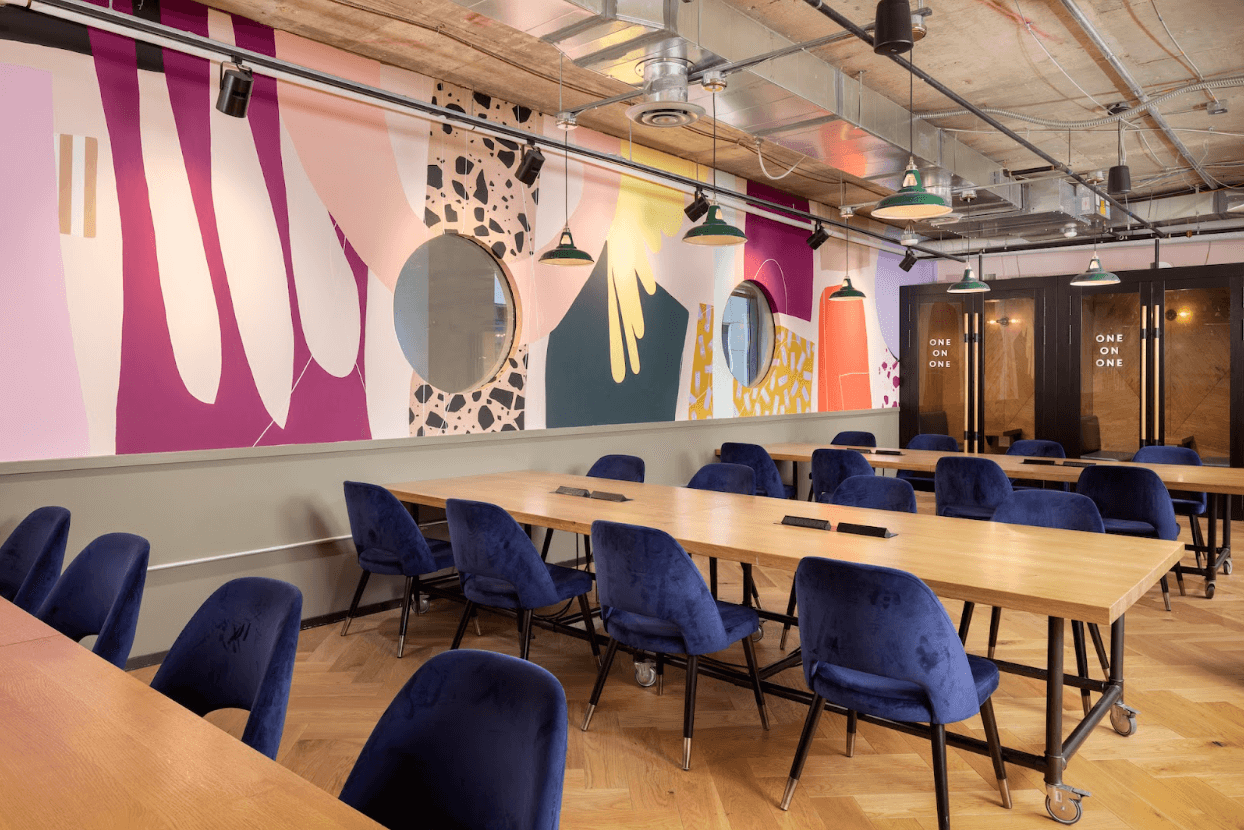
A creativity boost comes from working alongside people outside your usual field, whose different perspectives push your thinking in directions you wouldn’t reach alone. Casual conversations with someone from another industry cross-pollinate ideas in a way scheduled brainstorms rarely manage. Open layouts remove the usual hierarchy of who sits where, keeping exchanges loose and unstructured. Comfortable breakout spaces and interesting design choices, the kind you’ll find in a Mindspace location, add to the effect by giving your mind somewhere new to land.

6. Enjoy personal space with professional engagements
Personal space in a coworking context means you can step away from the open floor into a private office, suite, or booth whenever focus calls for it. Coworking isn’t one-size-fits-all. Freelancers and small teams often work well in open seating, while larger teams or anyone needing more privacy can book a private office or a customized suite, some with their own entrance. Meeting rooms and one-on-one booths cover the moments in between, and communal kitchens and lounges are still there when you want to be around people again.
This is one of the bigger shifts in coworking design lately. Spaces built a few years ago leaned almost entirely open-plan. Newer locations build in quiet zones and phone rooms alongside the open floor, because members kept asking for both collaboration and somewhere to disappear for an hour.
7. Coworking with like-minded people
Like-minded, here, means you’re likely to find other professionals in your own industry or a closely related one working in the same space. Coworking locations tend to draw clusters of similar businesses, tech and fintech being common examples, building something close to an industry hub inside a single building. At a location like Mindspace Miami, that means sharing a floor with founders and workers who think about problems the way you do, and who might share your priorities well beyond the workday.
8. Breaking out of your comfort zone
Breaking out of your comfort zone means trading a familiar setup, whether that’s your kitchen table or a traditional office, for a space designed to push collaboration. Coworking spaces lean into inspirational design and layouts built for interaction, which can feel like a lot if you’re used to working alone. For an introvert, that adjustment takes a minute. Push through it, though, and the same environment that felt like too much tends to become the thing that moves your work forward.
9. Reduce loneliness; increase connection
Reduced loneliness comes from being around other people again, something remote work and small teams tend to strip away. Working from home gets isolating fast, and a small team or a solo freelance setup can feel the same way even inside a traditional office. Coworking puts you back around people day to day. The social side supports your wellbeing on its own, and the professional side often turns into real collaborations and partnerships you wouldn’t have found working alone.
10. Cost-saving
Cost-saving means paying only for the space you use, month to month, instead of locking into a long-term lease. Coworking memberships scale up or down as your team changes size, so you’re never paying for desks nobody’s sitting at. That flexibility removes the long-term leases and fixed costs that traditional offices require. Membership fees also fold in overhead you’d otherwise manage yourself, maintenance, utilities, amenities, all handled, freeing up both your budget and your attention for the parts of the business that need it most.
More of these memberships are being paid for by employers now rather than out of an individual’s own pocket, which says something about how companies view the expense. It’s read less as a personal convenience and more as part of the real estate budget.

Coworking vs. working from home
Working from home sounds appealing until the dishes in the sink start competing with your inbox for attention. A coworking space removes that entirely: a dedicated desk, professional surroundings, none of the household noise pulling at your focus. You also land in a room full of other professionals, engineers, analysts, marketers, whoever else has a membership that day, and that mix creates real chances to meet people you’d never cross paths with from your kitchen table. High-speed internet, printers, and meeting rooms with proper video conferencing come standard, the kind of infrastructure most home setups don’t have. People tend to thrive under those conditions for one reason: the turnkey setup handles the logistics, so you can spend your energy on the work, the ideas, and the people around you instead of managing an office.
How to choose the right coworking space
Comfort
A comfortable environment does more for a productive workday than most people give it credit for. When you’re looking at a space, pay attention to the general feel of it, plus the ergonomics of the furniture itself. A well-set-up desk and a decent chair matter, and so do the lounge areas you’ll use between tasks. You want to feel settled in front of your laptop, alert enough to get through your list without your back complaining by 3pm.
Location
Location affects more than your commute. It shapes whether clients and partners show up for meetings, and whether your team sticks around long term. Mindspace Park Ofer Ha’Carmel sits at the heart of Haifa’s tech district with ocean views from the windows. Mindspace Münzstraße sits in central Berlin, Mitte, close enough to cafes, restaurants, and public transport that you can run errands on a lunch break without losing half the afternoon.
Amenities
Start with the basics: fast internet, working printers, someone handling the cleaning. Beyond that, look for the perks that make a space worth showing up to. Mindspace Williamsburg in Brooklyn has a full fitness setup, including a bouldering wall and a row of Peloton bikes, on top of the coffee and global access that comes standard at every Mindspace location.
Coworking with Mindspace
Coworking works for a solo freelancer and a two-hundred-person company for the same underlying reason: you get professional space, a built-in network, and none of the overhead of running an office yourself. If a physical desk isn’t what you need right now, a virtual office covers the professional address and mail handling without the space itself, worth a look if you’re not ready to commit to a desk. And if hot desking is new to you, that’s worth understanding too before you pick a plan.
Book a coworking day pass at a Mindspace location near you and see how these benefits play out in person, or look at membership options if you’re ready to make it permanent.
The Author

You might also like these reads — picked just for you.

Where to Rent Office Space in Amsterdam: Best Areas Compared
Amsterdam squeezes a remarkable range of business districts into a city you can cross by bike in half an hour. Pedal from a glass tower in Zuidas to a gabled canal house in the centre and the rent, the neighbours and the impression you make on clients all shift along the way.

Amsterdam Office Rental Prices: Why Flexible Workspace Is the Smarter Choice
You're comparing Amsterdam office costs, and the first numbers you'll find look almost too clean. A conventional lease runs 175 to 425 euros per square metre a year, depending on which postcode you're chasing. A serviced or flexible desk runs 250 to 800 euros a month, sometimes more, again shaped by district and building quality. Line those two numbers up side by side and the lease wins on paper, every time.
Renting a Small Office in Amsterdam: A Guide for Growing Teams
So your team is growing, and the spare room, the café corner and the borrowed meeting table aren't cutting it anymore. But you've still got options. When you rent a small office in Amsterdam, you're choosing between a dedicated coworking desk, a fully furnished private office, or a traditional commercial lease.
